
%20(2).png)
"Music expresses that which cannot be put into words." — Victor Hugo
For most of us, music is emotion. A song reminds us of our first school farewell. Another brings back memories of a family road trip. One instantly transports us to a wedding dance floor. Some songs become part of our childhood, while others quietly accompany us through heartbreaks and celebrations.
We rarely stop to think about what happens behind the scenes every time we press Play.
Last Sunday, while driving back home, an old Kishore Kumar classic began playing on Spotify. A few hours later, I scrolled through Instagram and heard the very same song in a travel Reel. That evening, while watching an OTT series, another evergreen Bollywood melody played softly in the background. The next morning, the gym playlist brought back yet another classic.
It made me pause.
The singer may no longer be performing. The composer may no longer be alive. The film left theatres decades ago.
Yet somebody earned money every single time that song was played.
Not once. Not twice. Millions of times.
That simple observation led me into one of the most fascinating industries I have researched in recent years.
Initially, I assumed companies like Saregama and Tips Music were simply music production houses. The deeper I went into annual reports, earnings calls, investor presentations and industry studies, the more I realised that I wasn't researching entertainment companies at all.
I was researching owners of intellectual property.
And that changes everything.
Unlike a factory that depreciates, or a machine that eventually becomes obsolete, a timeless song can continue generating royalty income for decades. Every new technology—from vinyl records and cassette tapes to CDs, MP3 players, Spotify, YouTube, Instagram Reels and whatever comes next—creates another avenue to monetise the same underlying asset.
The medium keeps changing.
The music doesn't.
That is why global private equity firms, sovereign wealth funds and institutional investors have increasingly begun treating music catalogues as infrastructure-like assets—long-duration, predictable cash-generating businesses that become more valuable as digital consumption expands. Saregama's management highlighted this shift, noting that global investors such as Bain, Apollo and KKR are actively investing in music catalogues because their value rises as subscription prices and digital monetisation improve.
Today, I want to take you through this fascinating industry—not as an analyst throwing around jargon, but as an investor trying to understand why some of the world's most valuable assets can neither be touched nor seen.
Whenever investors discuss structural themes, the conversation usually revolves around sectors such as defence, hospitals, railways, renewable energy or semiconductors. Rarely does anyone mention music.
Perhaps because we associate songs with emotions rather than economics. Yet India's music licensing industry sits at one of the most interesting structural inflection points in its history.
According to the industry research included in the supplied documents:
That gap between consumption and monetisation is what excites almost every management team in this industry.
One mistake many investors make is starting with financial statements. In this industry, understanding the value chain is far more important than memorising revenue numbers. Because once you understand where the money flows, every quarterly result suddenly makes sense.
Imagine a Bollywood movie is being made.
A composer creates the melody.
A lyricist writes the lyrics.
A singer records the song.
The producer finances the project.
At this point, a music label steps in. Companies such as Saregama or Tips Music purchase or fund the rights to that music.
From that moment onwards, they become the owners of the intellectual property. Now imagine where that one song can travel over the next 60 years.
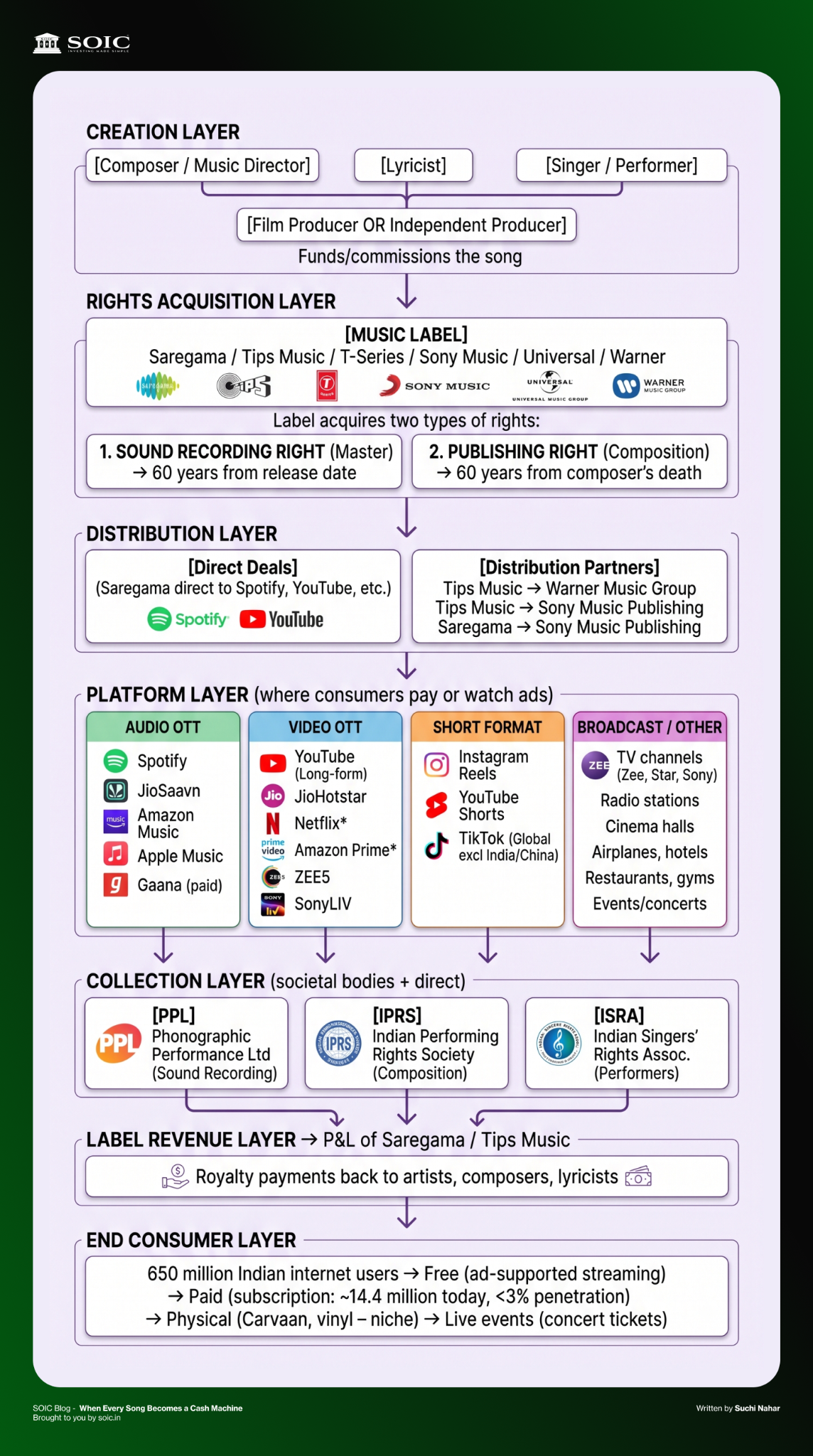
One Song. Twenty Different Revenue Streams.
This was probably the biggest surprise during my research. Most investors assume music companies earn only from Spotify or YouTube.
The reality is far richer. A single song can generate revenue through:
Each additional use creates another royalty stream while the original recording cost has already been incurred.
Think about that for a moment. A factory must manufacture another product before it can make another sale. A music catalogue doesn't. It simply waits for another listener.
One of the most misunderstood aspects of this business is that every song contains two separate rights.
This refers to the actual recorded version of the song. Whoever owns this right controls the commercial use of that recording for 60 years from publication. It can be licensed to streaming platforms, television, films, advertisements and broadcasters.
This relates to the underlying composition—the melody and lyrics. Publishing rights generate income whenever the composition is reproduced or publicly performed, often extending for decades under copyright law.
For a novice investor, this distinction is important because a company owning both rights generally has more ways to monetise a song than one owning only a portion of the rights.
Every industry has a defining economic characteristic.
Banks benefit from low-cost deposits.
Insurance companies benefit from float.
Software companies benefit from scalability.
Music licensing benefits from something equally powerful.
Infinite reuse of a finite investment.
A company spends money today to acquire or create content. If that content becomes popular, it may continue generating royalties for decades with minimal incremental cost.
The reports describe this elegantly:
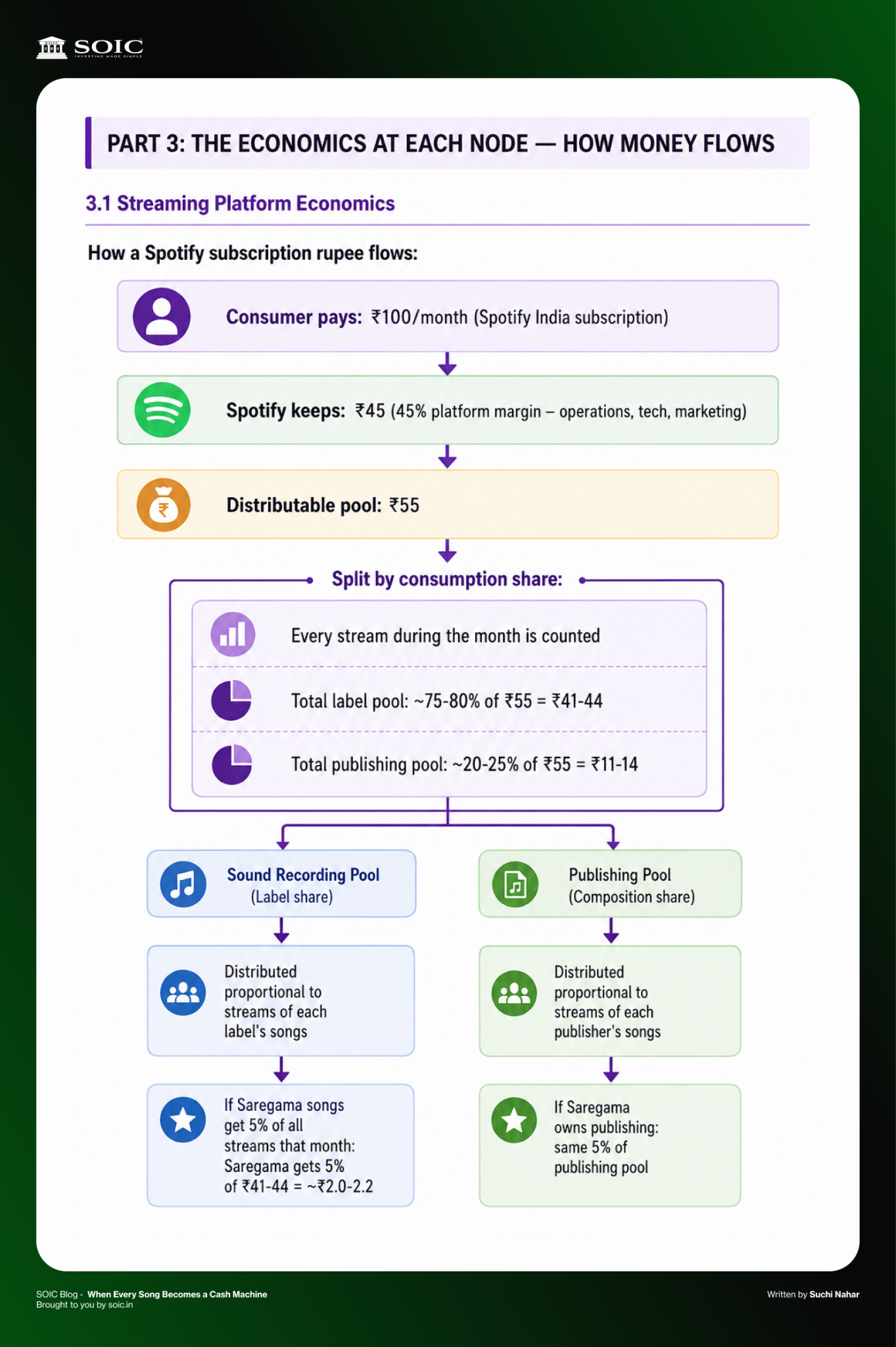
Content cost is largely incurred upfront, while revenue can continue for 60 years, allowing mature catalogues to achieve exceptionally high margins over time. This is why mature catalogue businesses often report EBITDA margins that most manufacturing businesses can only dream of.
Two Companies. Two Completely Different Playbooks. One Massive Opportunity.
If the industry is so attractive, which business model is better?
Interestingly, India's two listed music companies have answered that question in two completely different ways. One company is spending aggressively to build the next generation of evergreen music. The other is quietly harvesting one of the finest music catalogues ever built in Bollywood.
Both management teams believe they are right. And after studying every transcript, investor presentation and industry report, I realised something important.
Neither strategy is wrong. They simply optimise for different outcomes.
Think Like a Farmer… Imagine two farmers.
The first farmer owns a mature mango orchard planted 30 years ago. Every summer, he simply harvests fruits.
Minimal investment. Excellent cash generation. High profitability.
The second farmer buys more land every year. Plants thousands of new trees.
His profits remain lower today because he keeps investing. But twenty years later…His orchard becomes much larger.
That, in one simple analogy, explains the difference between Tips Music and Saregama.
If I had to describe Saregama in one sentence, it would be: An Intellectual Property Company disguised as an Entertainment Company.
Most people still associate Saregama with old Hindi songs. But management has spent the last few years transforming the company into a diversified IP powerhouse.
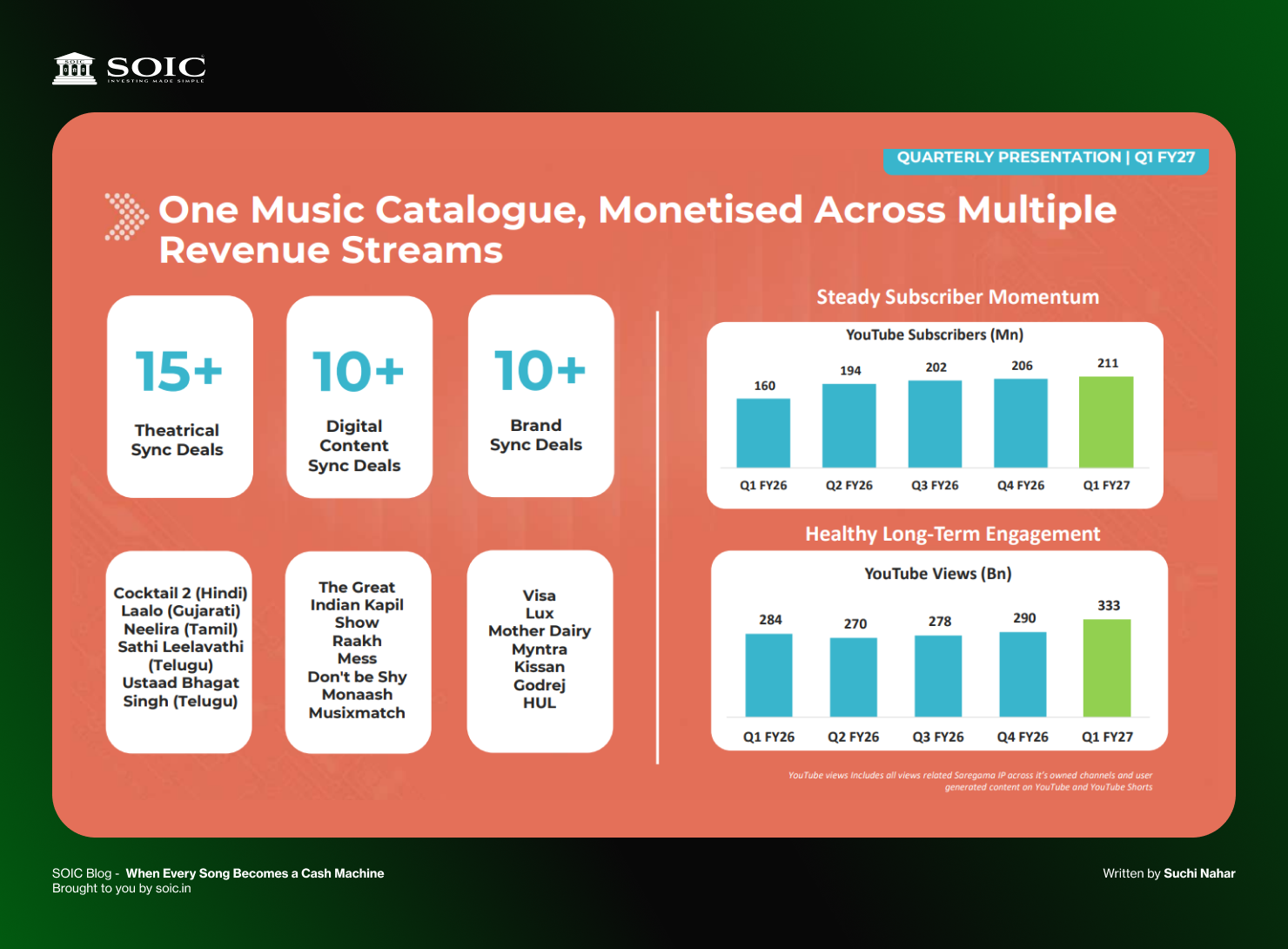
Today Saregama operates across:
Instead of depending only on old songs, it is continuously trying to create tomorrow's classics.
Its portfolio now includes:
This isn't merely diversification. It is an attempt to increase the number of intellectual properties that can be monetised repeatedly across multiple platforms. One phrase repeatedly appeared throughout Saregama's communication.
Building IP for Tomorrow.
The company is backing those words with capital.
During FY26, Saregama made its highest-ever investment in new music and catalogue acquisitions while continuing to grow revenue and profitability. Music revenue grew 17% YoY, music EBITDA increased 22%, and investment in new music and catalogue purchases reached record levels.
Many investors initially questioned why the company was spending so aggressively. Management's answer was refreshingly simple, if you want royalty income twenty years from now, you must invest today.
Unlike manufacturing companies where new capex creates production capacity, content investment creates future royalty annuities.
One of my favourite moments from the earnings call wasn't about revenue. It was about discipline.
Management explained that after the massive success of the Dhurandhar album, they deliberately refused to buy the rights for its sequel because the asking price did not satisfy their internal return requirements.
Their investment philosophy remains unchanged:
For long-term investors, this matters enormously. Owning great assets is important. Not overpaying for them is equally important.
Perhaps the most strategic move undertaken by Saregama during the year was its investment in Bhansali Productions. Instead of competing in auctions for blockbuster film music every year, the company secured a strategic relationship that provides access to marquee Hindi film music at predetermined economics over the next few years.
Management indicated that this arrangement strengthens visibility for upcoming releases while improving capital allocation.
Upcoming projects include:
These are not merely film releases.
They are potential future royalty assets.
One observation repeatedly surfaced across the calls. India is no longer a Hindi-only music market.
Consumption across Telugu, Tamil, Punjabi, Bhojpuri, Marathi and Malayalam continues to expand rapidly.
Recognising this shift, Saregama has been investing aggressively in regional catalogues and management, specifically highlighting Punjabi music as an area where it intends to strengthen its presence over the coming quarters.
For investors, this reduces dependence on a single language while widening the addressable market.
If Saregama resembles a growth investor, Tips resembles an outstanding capital allocator.
The company has chosen an entirely different philosophy. Rather than building a large entertainment ecosystem, Tips focuses almost exclusively on one thing: Owning and monetising music.
Its catalogue includes more than 34,000 songs across 25+ languages, with approximately 75% of revenue generated through digital platforms. It also operates with a debt-free balance sheet and substantial cash and investments.
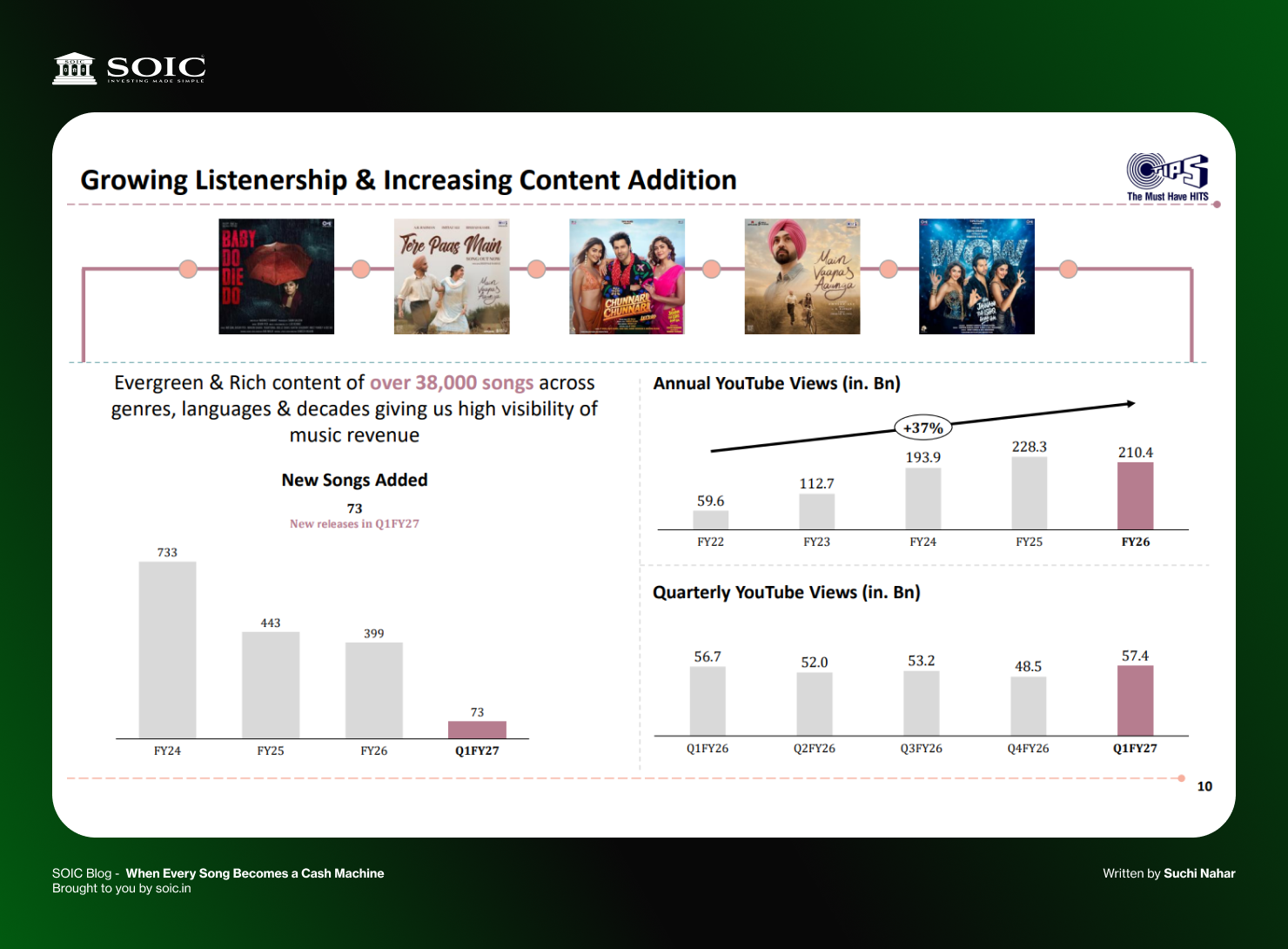
This focus has translated into exceptional profitability. The industry report highlights Tips' ability to generate industry-leading EBITDA margins through disciplined monetisation of its catalogue.
One fascinating detail emerged from Tips' investor communication. Unlike many content businesses that amortise content costs over several years, Tips expenses 100% of new content costs in the quarter of release.
Why does this matter? Suppose Tips spends ₹40 crore acquiring new music. The entire expense hits the income statement immediately. However, the revenue from that music may continue flowing for decades.
In other words, short-term reported earnings can appear weaker even though the economic value of the catalogue continues to grow. Understanding this accounting policy prevents investors from misinterpreting quarterly volatility.
Another characteristic that distinguishes Tips is its shareholder-friendly capital allocation. During its Q1 FY27 earnings call, management reiterated its commitment to distribute the previous year's profits through dividends and buybacks while continuing to invest ₹90–100 crore annually into fresh content across films, regional music and independent releases.
This demonstrates an important balance. The company is not sacrificing future growth. Nor is it hoarding unnecessary cash.
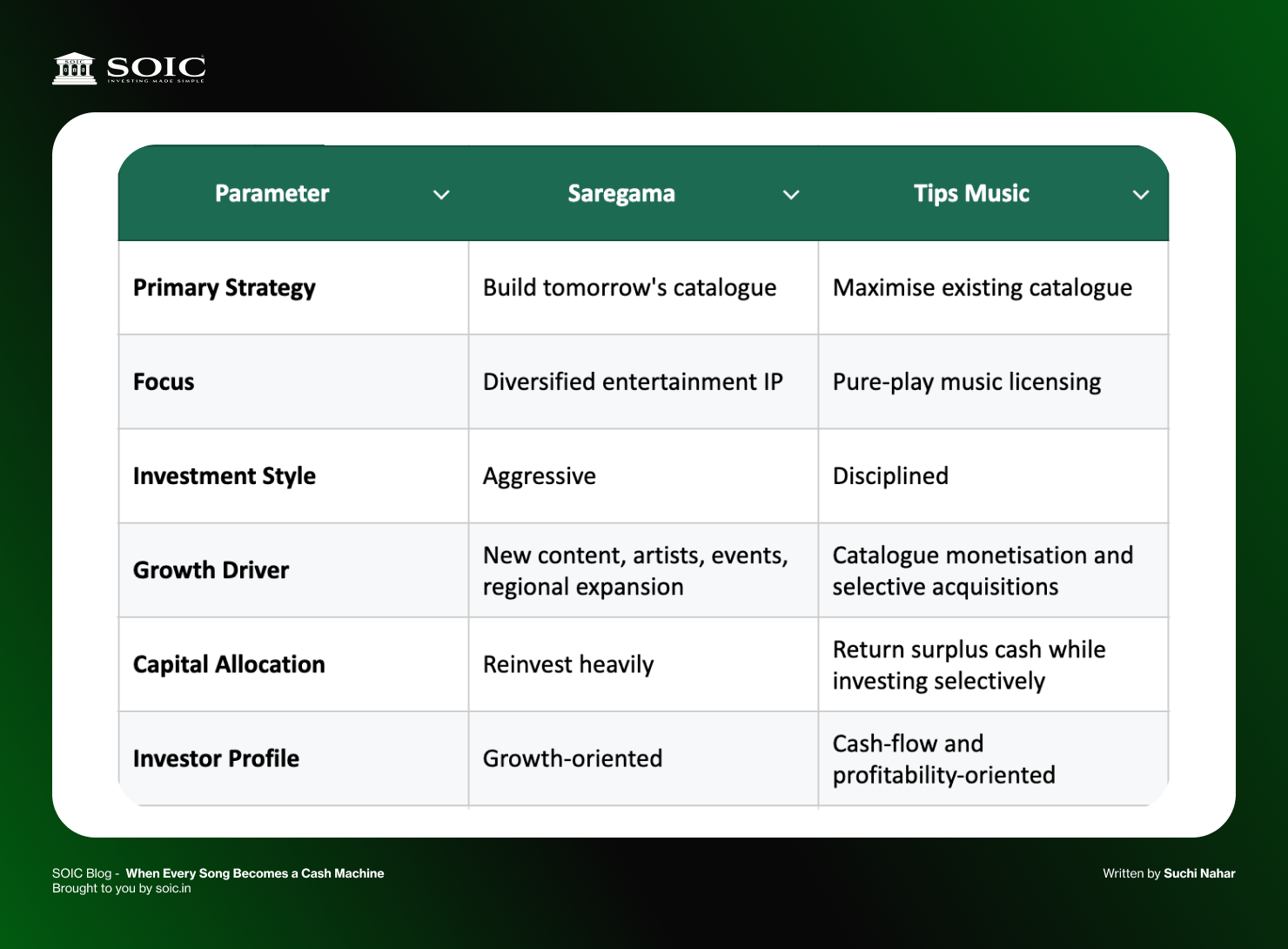
Neither model is inherently superior. Your preference depends on your investment philosophy. If you believe India is entering a long structural upcycle in music consumption, Saregama's aggressive investments may create significant long-term value. If you prioritise capital efficiency, high margins and shareholder returns, Tips offers a compelling alternative.
One of the advantages of reading multiple earnings calls instead of just financial statements is that recurring themes begin to emerge. Across both companies, several messages appeared again and again.
1. India Is Still Under-Monetised
Both management teams repeatedly emphasised that India's paid streaming penetration remains among the lowest globally despite one of the world's highest levels of music consumption.
The opportunity is not necessarily to make Indians listen to more music—they already do. The opportunity is to monetise that listening more effectively.
2. Digital Will Continue To Dominate
Streaming platforms, YouTube, Shorts and social media remain the biggest growth engines. As premium subscriptions increase, royalty pools should expand.
3. Regional Music Is Becoming Increasingly Important
South Indian languages, Punjabi music and independent artists are becoming meaningful contributors to future growth. The era when Bollywood alone drove the industry is fading.
4. Capital Discipline Matters
Interestingly, neither management advocated indiscriminate spending. Both repeatedly stressed return-based decision making. That is reassuring because content acquisition can quickly become value destructive if management begins chasing prestige rather than returns.
Perhaps the biggest takeaway from studying this industry wasn't hidden in a financial ratio. It was hidden in management behaviour. Neither company is trying to maximise the next quarter. Both appear focused on maximising the value of their catalogue over decades. That is exactly how businesses built on intellectual property should think.
Risks to track:
When I began researching this industry, I thought I was studying two entertainment companies. By the end of this research, I realised I was actually studying businesses that manufacture cash-generating intellectual property. Every blockbuster eventually fades. Every smartphone eventually becomes obsolete. Every factory eventually needs replacement.
But a timeless song continues earning through every new technology—from cassettes to CDs, MP3 players, streaming platforms, YouTube, Instagram Reels, and perhaps technologies that don't even exist today.
The medium changes. The music doesn't.
As investors, we often chase businesses with visible assets—factories, warehouses, machines, and land. Yet some of the most valuable businesses own assets you cannot touch.
A melody. A lyric. A memory.
Companies like Saregama and Tips Music aren't merely creating songs; they are building libraries of intellectual property that can compound for decades. One chooses to aggressively invest in tomorrow's catalogue, while the other maximises returns from an already proven one. Different paths, but both are centred on owning assets that become more valuable as digital consumption rises.
The next time an old Bollywood classic unexpectedly appears in your playlist, pause for a moment. Someone, somewhere, just earned another royalty.
And perhaps the biggest lesson from this industry is this:
The world's best businesses don't always manufacture products. Sometimes, they simply own memories.
Disclaimer: The information provided is for educational purposes only and should not be considered investment advice. We are SEBI-registered research analysts.
We believe that investment decisions should be based on personal conviction and not borrowed from external sources. Therefore, we do not assume any liability or responsibility for any investment decisions made based on the information provided in this reference.



.avif)
0 Comments