
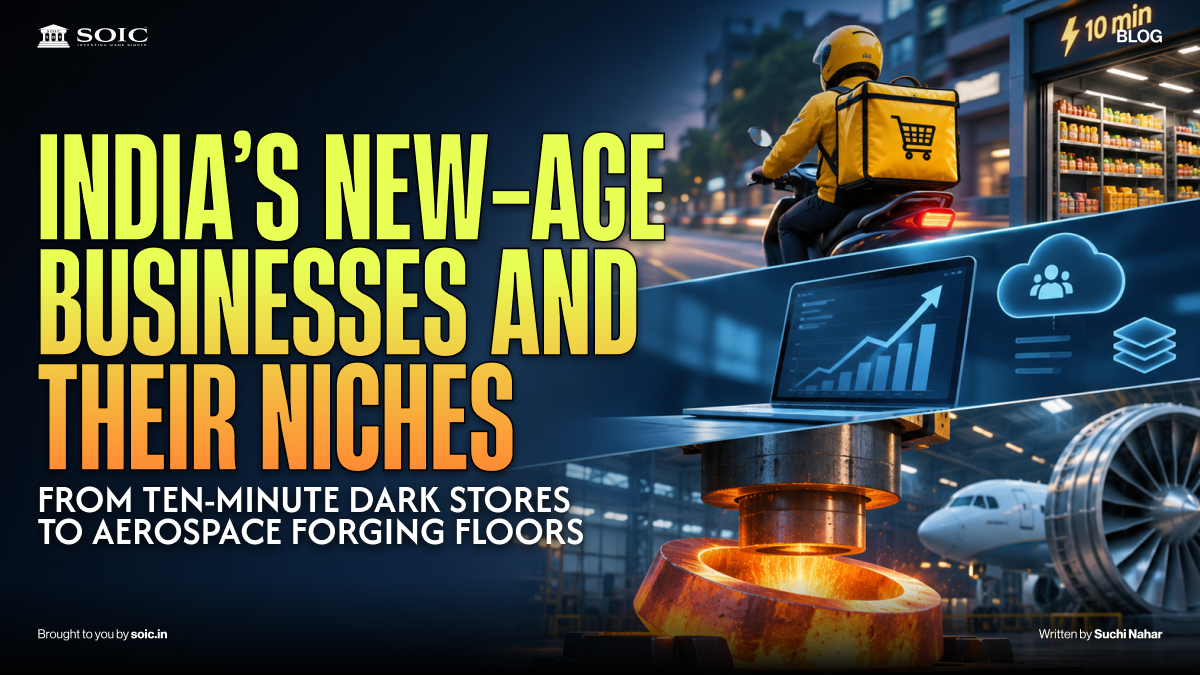
Order ₹530 of groceries on Blinkit tonight. Of that, ₹387 goes to the goods, ₹116 to the rider and dark store, ₹27 to corporate overheads, and what is left is... roughly zero. Blinkit is the winner of quick commerce. Now walk into a forge. A tonne of metal sold as a rough casting fetches about ₹1.3 lakh (Ramkrishna Forgings' disclosed realisation).
Forged and machined at Happy Forgings, it fetches ₹2.5 lakh, and the next order book on the same presses is priced at ₹3.43.5 lakh. Same metal, nearly 3x the money. Two worlds with nothing in common: one of apps and gig riders, the other of presses and five-axis machines. But strip away the labels, and both ask one question: Is there something here that the next well-funded rival simply cannot copy?
The Fork — Every new-age business reaches a fork. One branch leads to pricing power, operating leverage, and cash compounding. The other leads to discounting, cash burn, and commoditisation. The same idea can go either way: in edtech, the same liveclass idea produced both PhysicsWallah and Byju's; in quick commerce, the same darkstore model produced a Blinkit at breakeven and a Zepto that lost ₹5,042 Cr in a year.
➤ What decides the branch is not the size of the market. It is whether the business builds a moat the next ten funded startups cannot cross.
Manufacturing has the same fork, just in overalls. There are only two kinds of growing manufacturing setups. The first is the industry the government built: capacity exists because a scheme made it viable, everyone gets the same incentive and the same imported line, so the subsidy is the only moat, and it has an expiry date. The second is the manufacturer with something to defend: a hard-to-copy process, long customer qualification, and a balance sheet that survives the downcycle while weaker capacity shuts. The first is a capex story that ends when the policy does. The second is a compounding story; the cycle only decides the timing.
Our lens for platforms is the SOIC Monopoly Test: high entry barriers, can't be replicated with a blank cheque, a data flywheel, network effects, it becomes a verb, operating leverage, few real competitors, and genuinely cutting-edge. A real monopoly ticks most. A hypercompetitive pretender ticks two.
Five moats, in number
1. Data becomes the new J-curve: Through 2025, the headlines said ChatGPT would kill Google. Instead, Alphabet's Search revenue went from $49.4 bn (Q324) to $63.3 bn (Q226), up 28% in two years, with growth accelerating from 10% to 19% through the AI search shift. Google Cloud grew 82% on a $514 bn backlog, and Gemini crossed 950 million users. Search funded YouTube, which funded Workspace, Cloud, and Gemini. One monopoly quietly becomes five, because every query tells it what to build next.
2. It becomes a verb: You don't search; you Google. You don't send money, you Paytm karo. The strongest switching cost is not a contract; it is a habit so deep the brand replaces the noun.
3. Network effects: Meta reaches 3.58 billion people a day: more users, sharper prediction, more revenue, reinvest, and more users. Netflix's co-CEO now names YouTube and Instagram as direct competitors. These monopolies are fighting over one fixed resource: your time.
4. The cost of replication is too damn high: Before its first annual profit, Paytm absorbed about ₹16,600 Cr of losses; Eternal about ₹6,500 Cr. A challenger today has to fund that same education of merchants, users and regulators all over again. Enduring that burn is the moat.
5. Then comes operating leverage: CarTrade's EBITDA has compounded at 66% against 22% revenue growth (FY23 to FY27, Q1 annualised), margin 9% to 31%. In Q1 FY27, Paytm's EBITDA grew 182% on 28% revenue growth. Build once; each new rupee drops to profit.
A monopoly position is not a monopoly runway. IndiaMART has every textbook moat: 8.8 million supplier storefronts, a ₹2,014 Cr customer float, and 3740% EBITDA margins. But paying suppliers has been flat at about 218K for three years, unique enquiries fell from 29M to 26M, and growth is now almost entirely ARPU-led. The CEO himself spoke of hitting "a little bit of a saturation point." Vertical B2B players are unbundling it, and AI search is moving in between buyer and marketplace.
China shows both the end state and the risk. Tencent's WeChat is one habit 1.41 billion people cannot leave. Yet the 2021 crackdown wiped out more than $100 bn in 48 hours, and one rule erased the entire for-profit tutoring sector overnight. The hidden risk to every monopoly is not competition; it is the regulator.
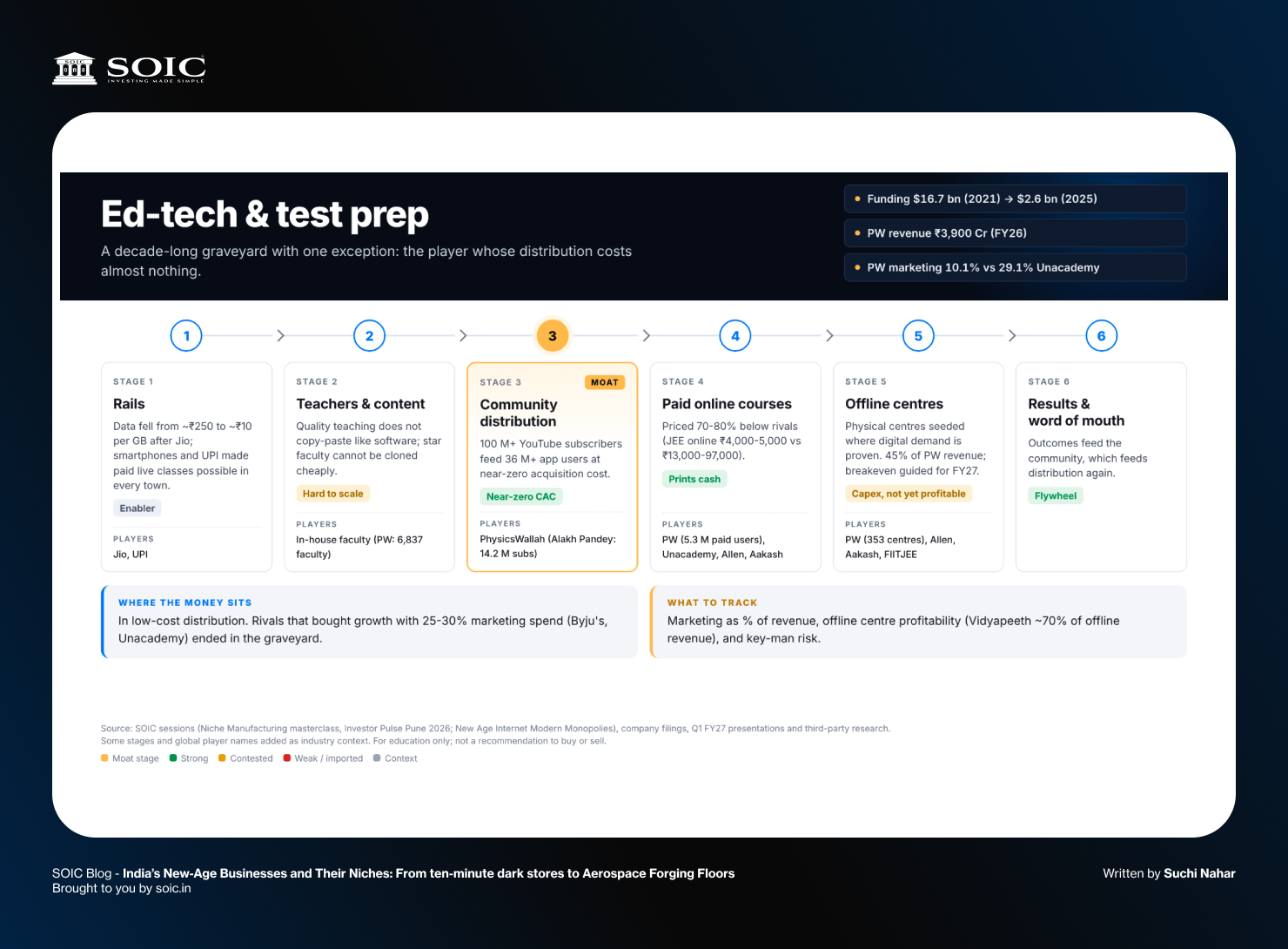
Global edtech funding went from $16.7 bn in 2021 to $2.6 bn in 2025. Byju's went from $22 bn to zero; Unacademy is set to be sold to UpGrad at roughly 90% below its peak. Cash bought growth, never retention.
PhysicsWallah got out of the graveyard by making quality the cheapest option in the room. Its first paid batch in 2020 cost ₹999 and filled with 50,000 students in ten days. Revenue went from ₹744 Cr (FY23) to ₹3,900 Cr (FY26). Its funnel runs from 100M+ YouTube subscribers to 36M+ app users acquired at near-zero cost. In FY24, it spent 10.1% of revenue on marketing; Unacademy spent 29.1%. A rival with a billion dollars can buy ads. It cannot buy Alakh Pandey's face. The bear case is the same face: keyman risk, plus offline execution and regulation.
UPI charges merchants zero MDR, so the volume winner does not automatically win the profit; money is made in the merchant layer (devices, credit, insurance). Paytm can be number three on UPI and still be the one inflicting: 1.57 crore soundboxes and card machines paying rent every month, FY26 PAT of ₹552 Cr, and ₹13,529 Cr of net cash. Pine Labs drops ₹5057 to EBITDA from every ₹100 of incremental contribution. The inflection is real; the regulator is the permanent asterisk.
Watch for the capital cycle turn. When the sector leader lists (PhonePe, 46.9% of UPI volume, is coming as a 100% offer for sale), the market prices it on earnings, not growth. The burn ends, rivals follow, discounts fade and listed peers rerate. A dominant player's IPO is the bell that ends the burn.
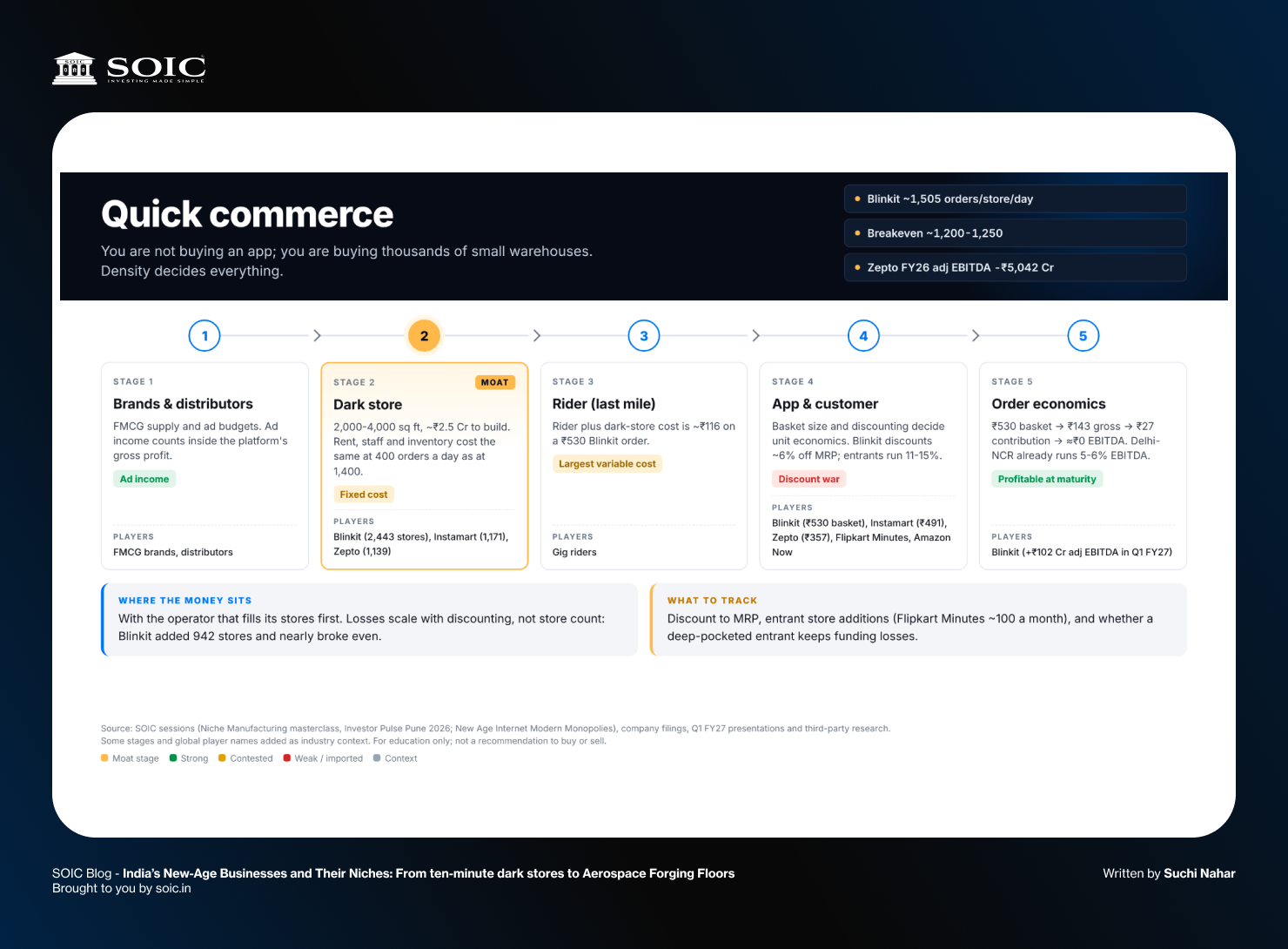
In quick commerce, you are not buying an app; you are buying thousands of small warehouses. A dark store costs about ₹2.5 Cr, its costs are fixed, and breakeven is roughly 1,2001,250 orders a day. Blinkit runs about 1,505.
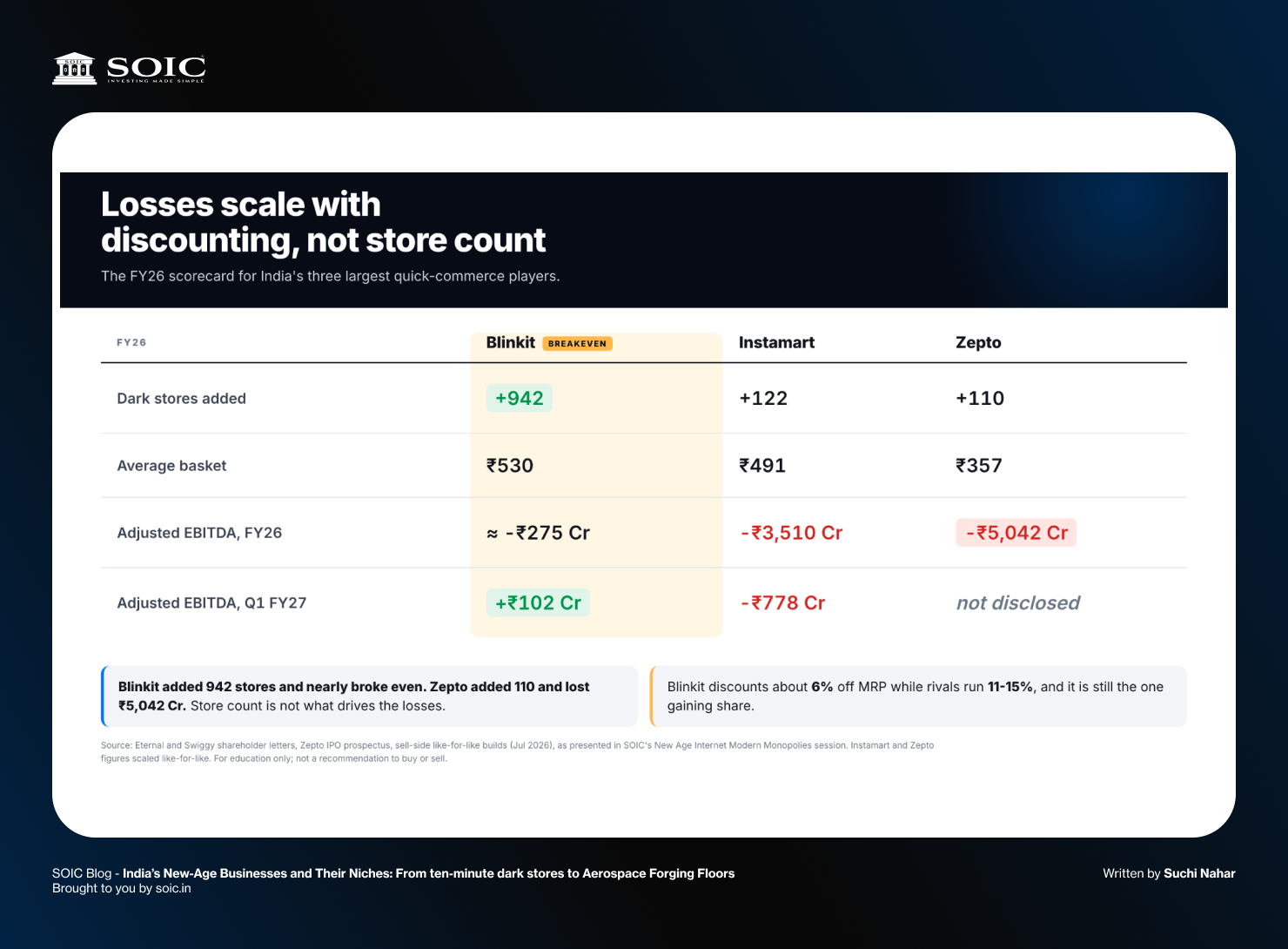
Losses scale with discounting, not store count. Blinkit discounts about 6% off MRP, while rivals run 1115%, and it still gains share. The bear case has a name: deep pockets. Flipkart Minutes and Amazon Now have built roughly 1,600 dark stores and funded them from an annual budget. Value retail needs cheap rail. Ten minutes is not a cheap rail.
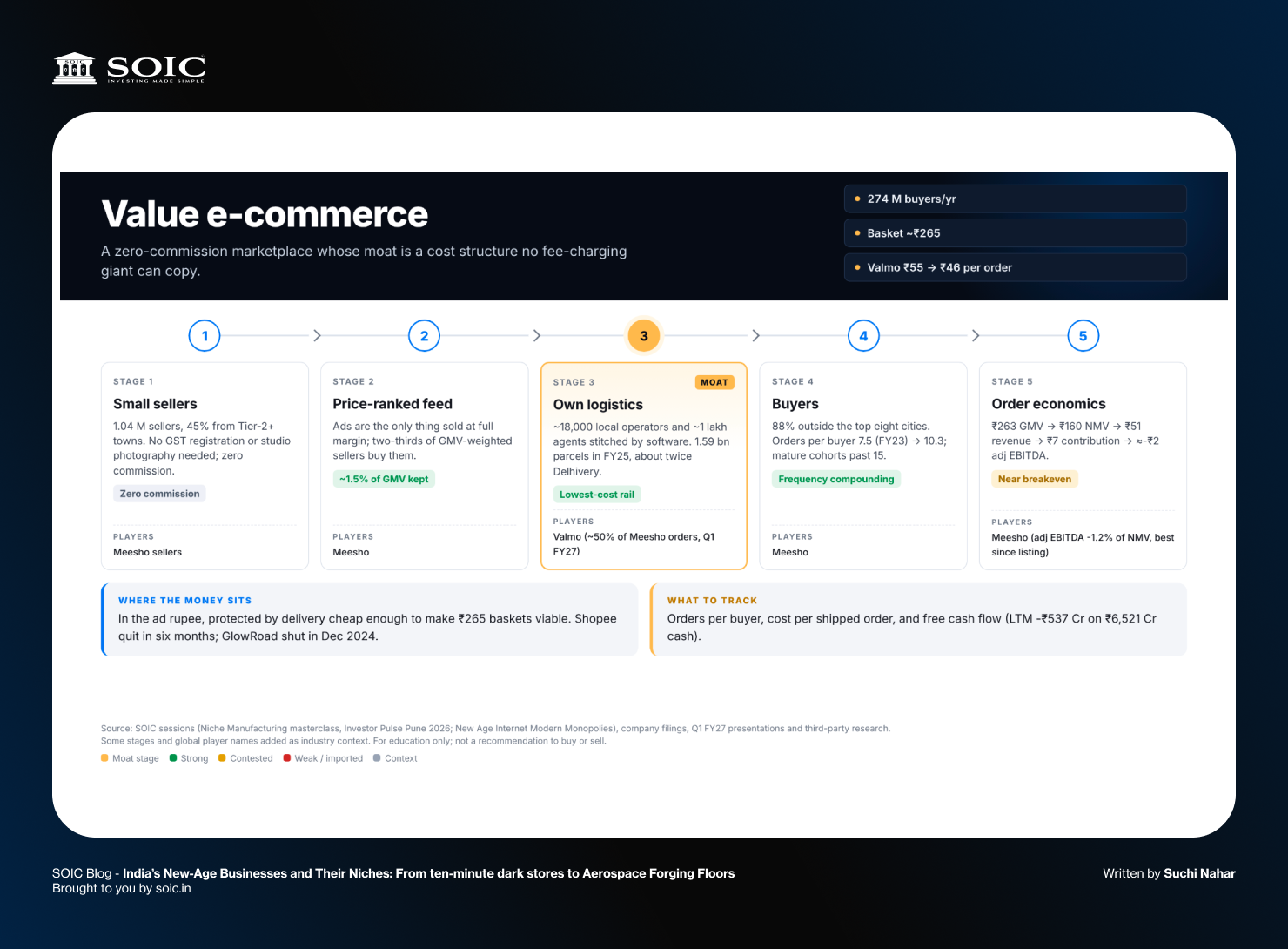
Meesho is the cheapest rail in Indian retail. One in five Indians buys there with a basket of about ₹265, and sellers pay zero commission. Its own logistics arm, Valmo, cut the cost per shipped order from ₹55 to ₹46. The flywheel: cheaper delivery makes cheaper goods sellable, which brings more orders, denser routes, and cheaper delivery again. Shopee quit within six months, and Amazon's GlowRoad shut in December 2024. What nobody copied was the cost structure.
From Cost to Control
For thirty years the world ran on Stan Shih's smile curve: keep design and brand, and sell the middle (assembly) to wherever labor is cheapest. It worked brilliantly, but it rested on one unpriced assumption: that the buyer would always be able to buy.
Then China stopped renting the IP and started writing it. Huawei now holds 9,597 standard essential 5G patents against Qualcomm's 8,046. Dependency got weaponised: rare earth controls, gallium and germanium licensing, and Nexperia chip exports were blocked in 2025 while VW and Volvo warned of shutdowns. The lever is never the resource itself. It is the one processing step everyone routed through the same country.
So states now optimise for control, not cost. The new bargain: you may sell here if you make it here. India's PLI has grown to 17 tranches and about ₹3.6 L Cr of outlay. The map is clear. Of India's $752.7 bn import bill, 386.5bn is manufacturable,and two lines alone,electronics(100.5 bn) and machinery ($70.7 bn), add up to $171 bn a year. That is not a theme. That is the map.
Your index doesn't own it. The Nifty 50 carries 36.18% in financials and 1.24% in capital goods. In five of the last six quarters, the median Nifty Manufacturing company grew profits faster than the median Nifty 50 company. The Nifty is a museum of the last regime.
Manufacturing has been one of the worst places to compound capital in India for thirty years. PTC Industries earned an 8% ROCE even after revenue nearly doubled in FY26. Less than 1% of the ₹6,940 Cr bulk drug PLI has been disbursed. China flooded Aarti Industries' segments, and its margin fell from 21.8% to 16.5%. The ACC battery PLI targeted 50 GWh; 1.4 GWh has been commissioned.
Even hot niches get crowded. Vikram Solar's revenue rose to ₹1,563 Cr while its operating margin fell from 21.2% to 8.1%. Transformer maker Shilchar's margin halved from 33% to 16%. The announcement always runs ahead of the revenue.
➤ These companies used to sell weight. The ones that rated started selling work.
The KPI is realisation per kilo. On our illustrative ladder, raw forging passes steel prices through at around ₹150/kg; machining, assembly, and aerospace certification climb toward ₹450/kg. The proof sits inside one industry. Nelcast's operating margin drifted down to about 7%. Steelcast's rose to about 27%, and Happy Forgings has held 2731% since FY21. Same metal, very different outcomes. The gap is about who the customer trusts to finish the part.
Aerospace – the constraint moved from demand to delivery. Airbus and Boeing sit on 1112 years of backlog, and engines, castings, and forgings are the bottleneck. Collins, Rolls-Royce, GE and Safran are all expanding in India now, and India's aerospace exports grew at a 22% CAGR to about ₹252 bn in 2025E. Yet every one of the ten best-known Indian component makers has revenue under ₹10 bn. Scale is missing, not capability. NRB Bearings' Harshbeena Zaveri on a Sukhoi30 bearing order: "a handful of companies in the world, not even five, that can make this type of bearing."
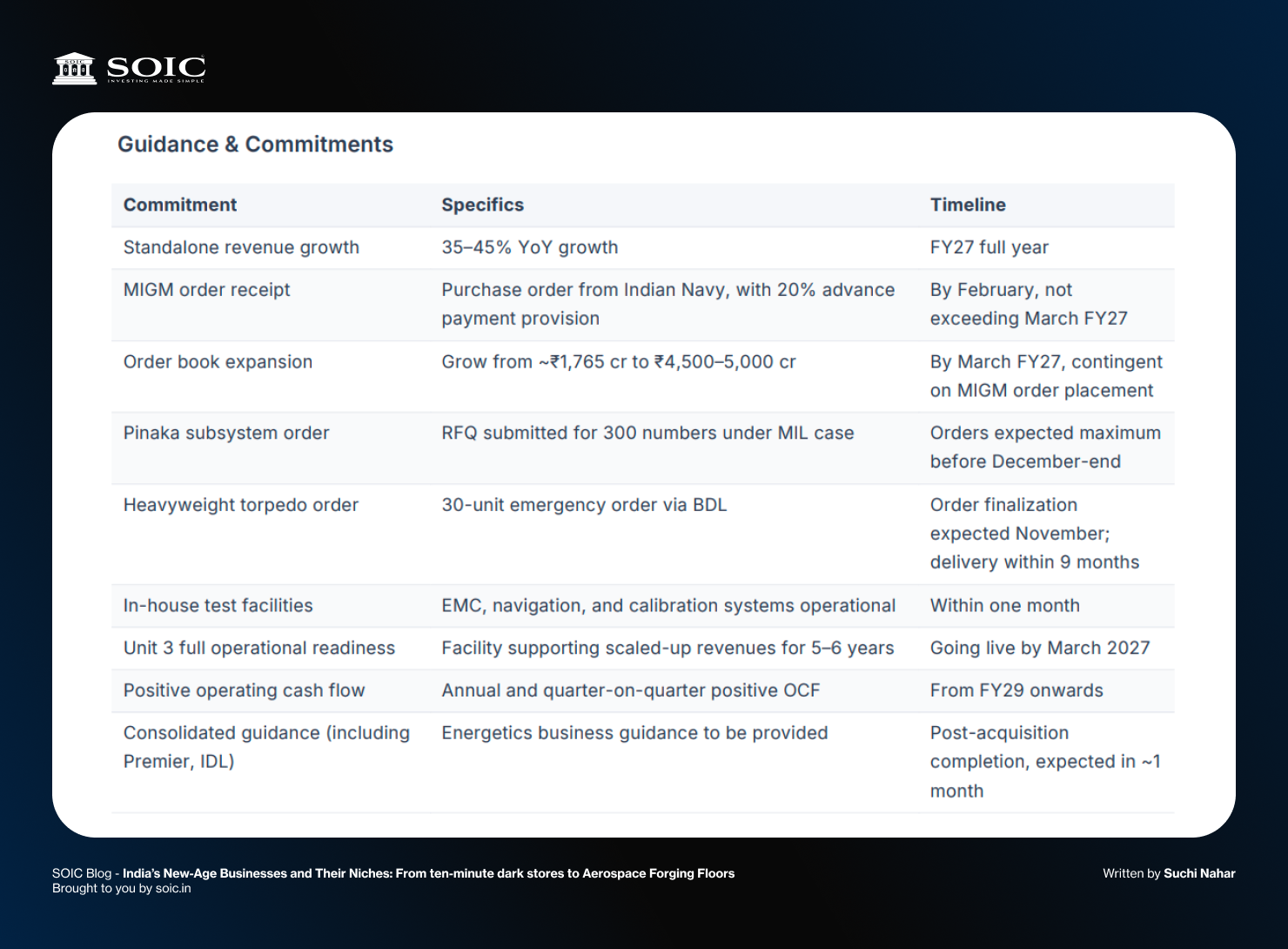

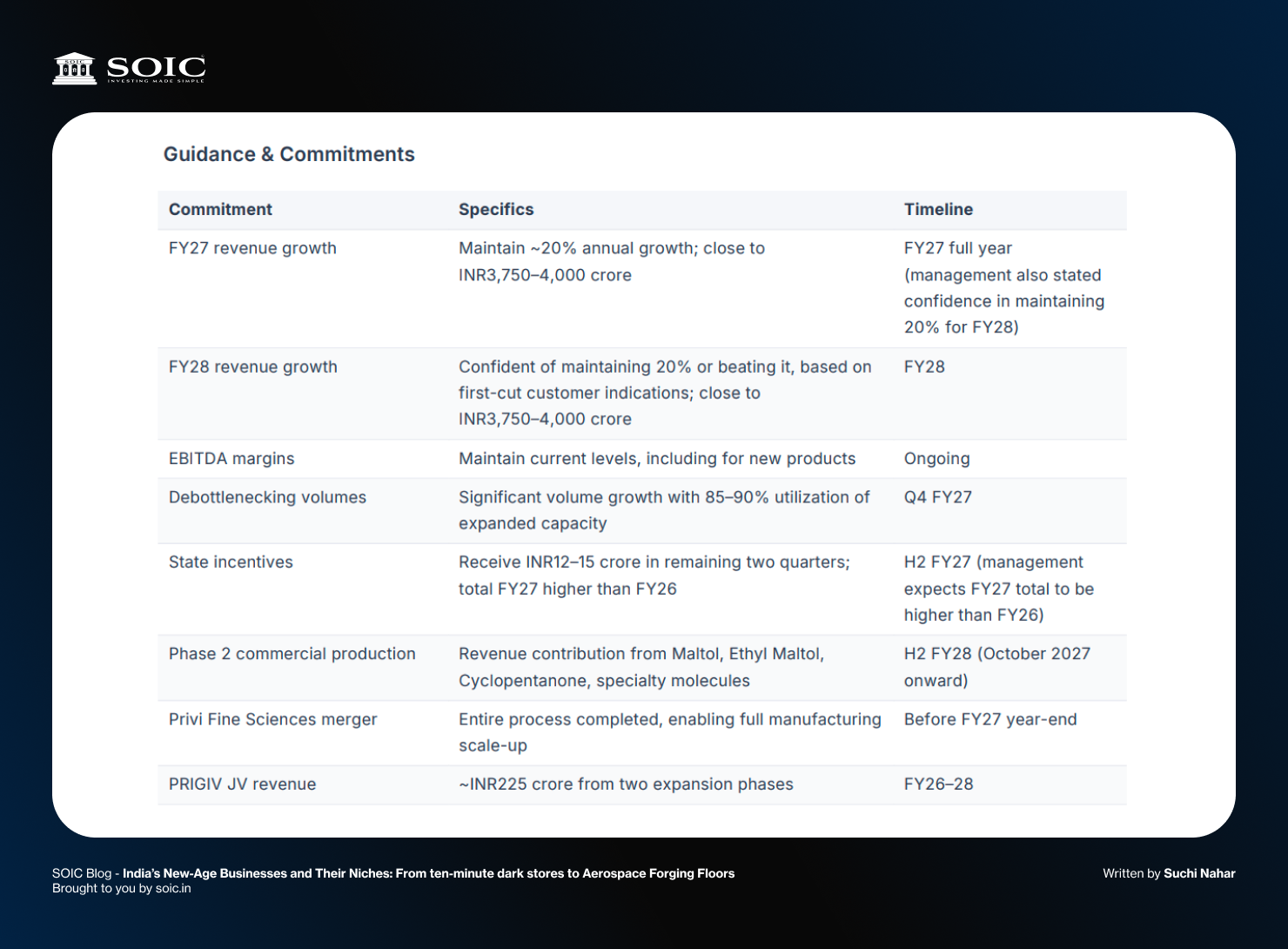
Specialty chemicals: ₹/kg does the work. There are three tiers, not two: commodity (price follows the cost curve), fine chemicals (cost-plus service businesses), and true specialty (value-in-use pricing). In real specialty, gross profit per kilo holds through feedstock cycles; in fake specialty it moves 1:1 with feedstock. Manorama (27.1% EBITDA margin, cocoa butter equivalents from forest seeds) and Privi (25.8%, 20%+ global share in ten aroma molecules) earn specialty margins in businesses that look like commodity processing. At Fine Organic, the moat is approval: three to five years to get a food additive qualified.
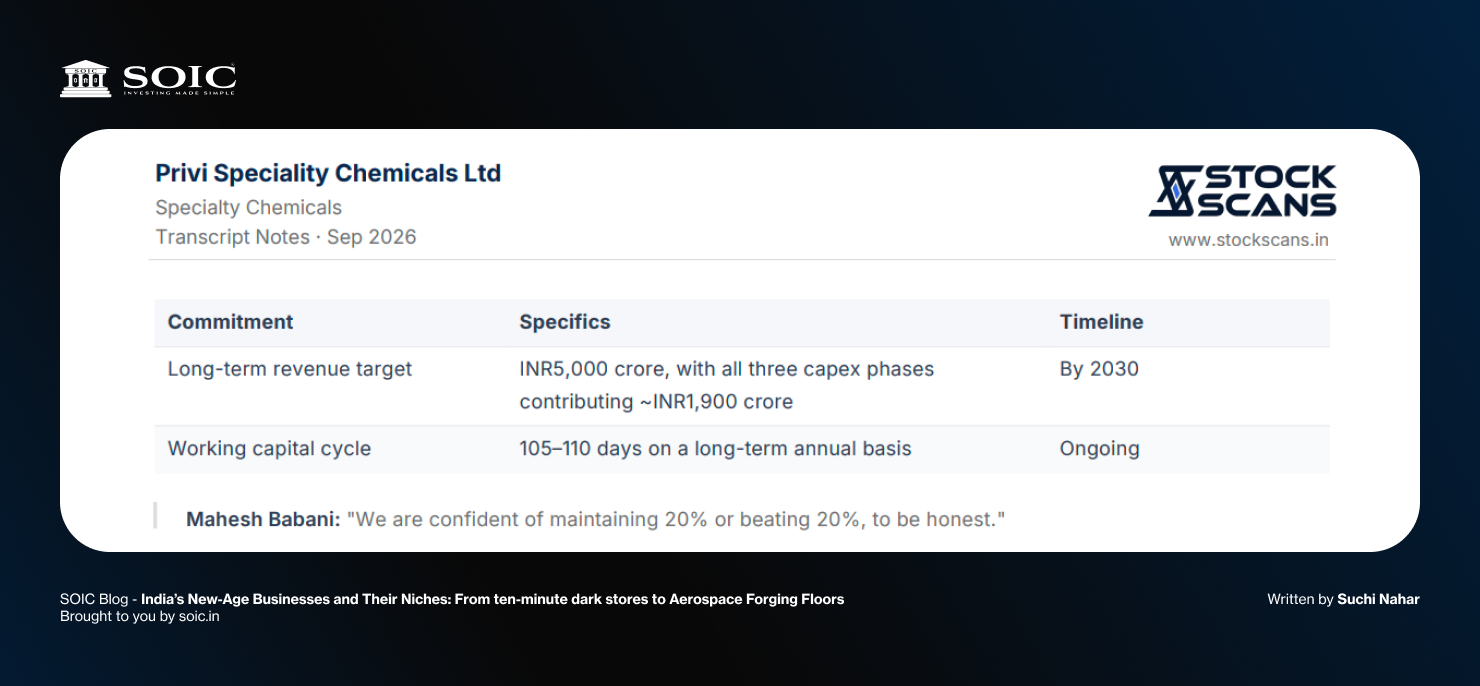
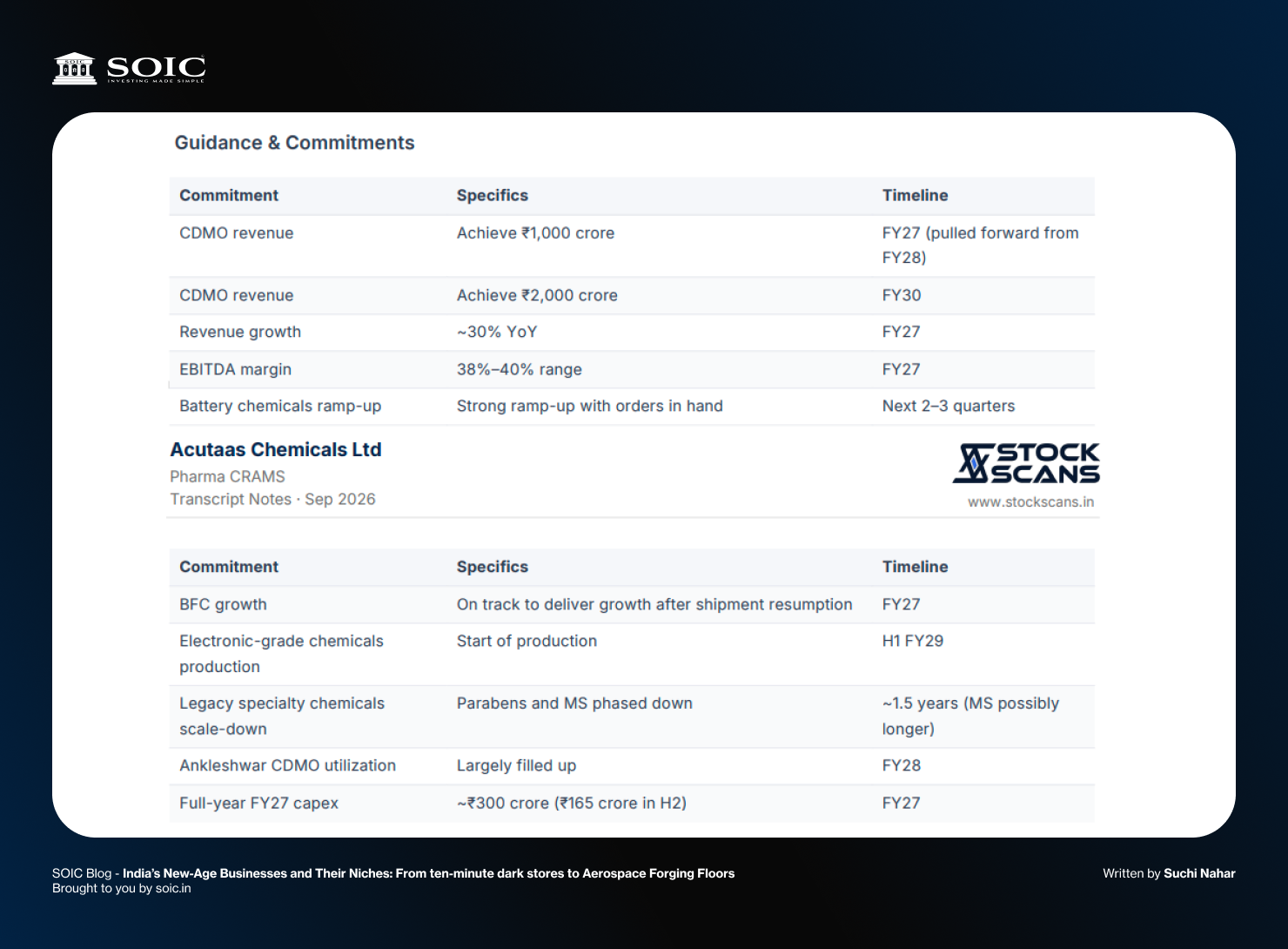
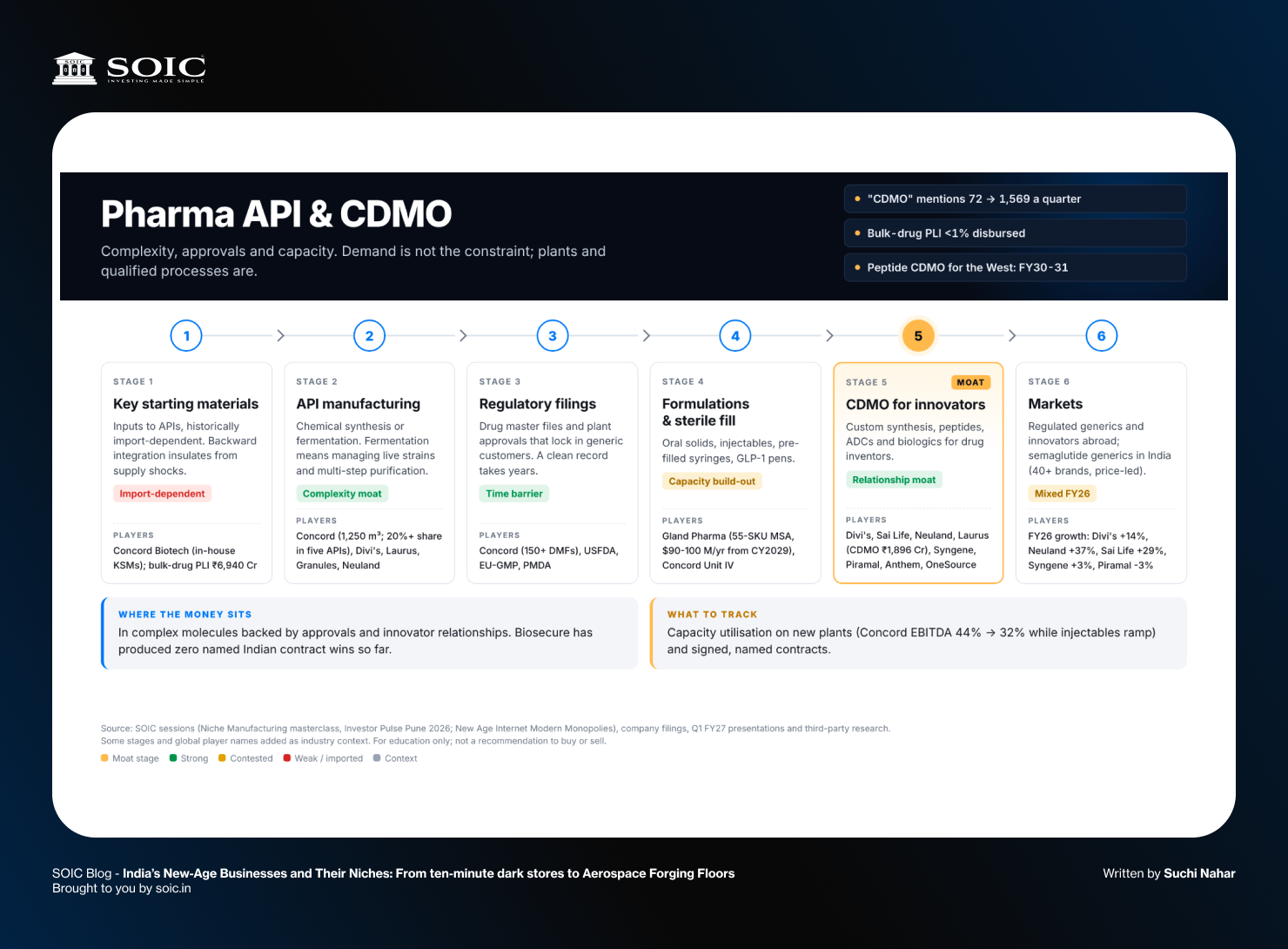
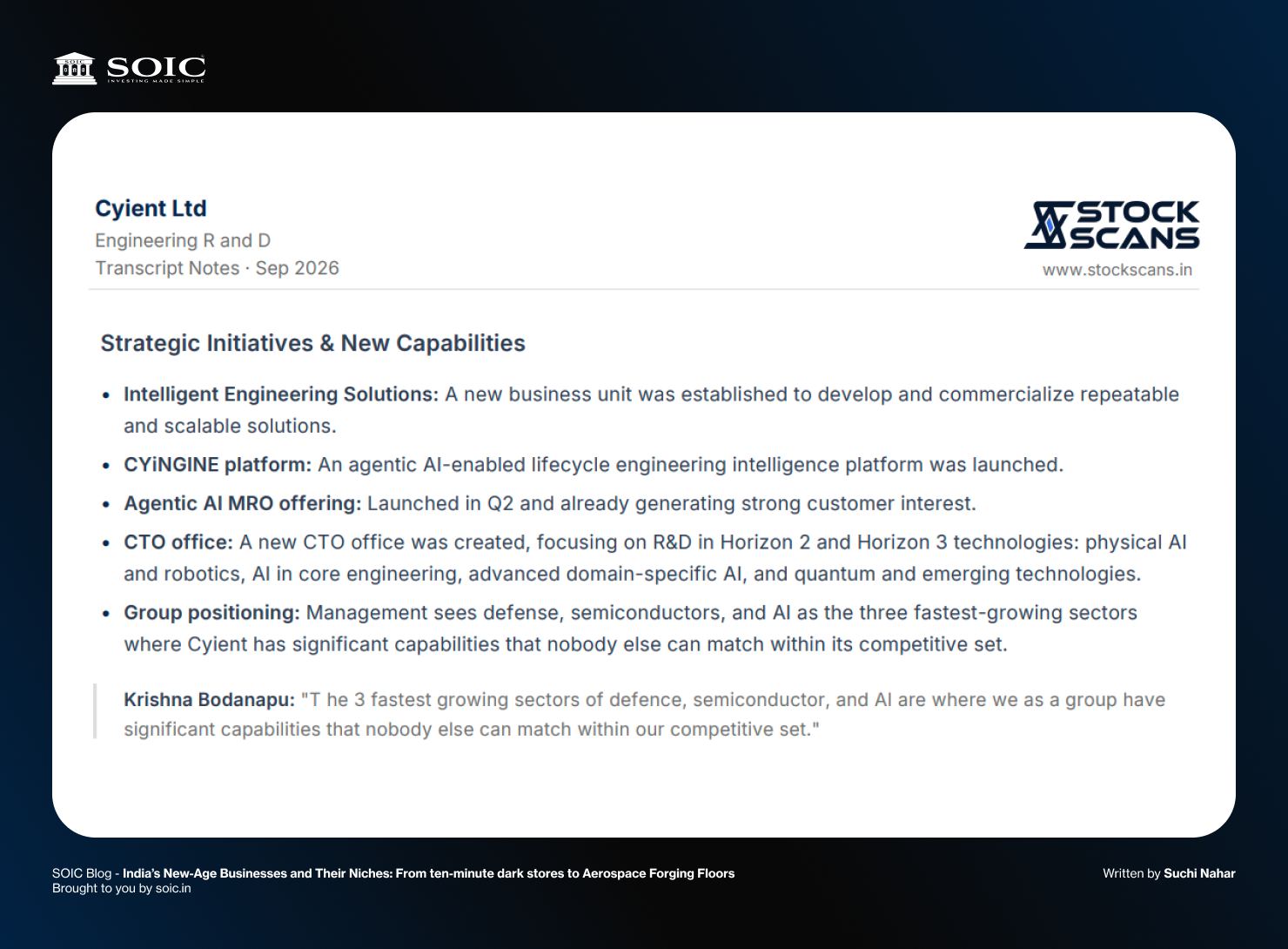
Pharma CDMO: capacity is the constraint. Concord Biotech makes APIs by fermentation, which is far harder to copy than synthesis, and holds 20%+ global share in five molecules. But be honest about the cycle. Its EBITDA margin slipped from 44% to 32% as new capacity came on ahead of revenue. Across the sector FY26 was "a mixed year, not a boom", and the GLP1 peptide opportunity for the West is an FY203031 story. Acutass management recently said – Pipeline depth: Eight to nine products are entering the revenue stream over the next one to one-and-a-half years, with some described as "very exciting projects" carrying revenue potential above the typical ₹50–100 crore range.
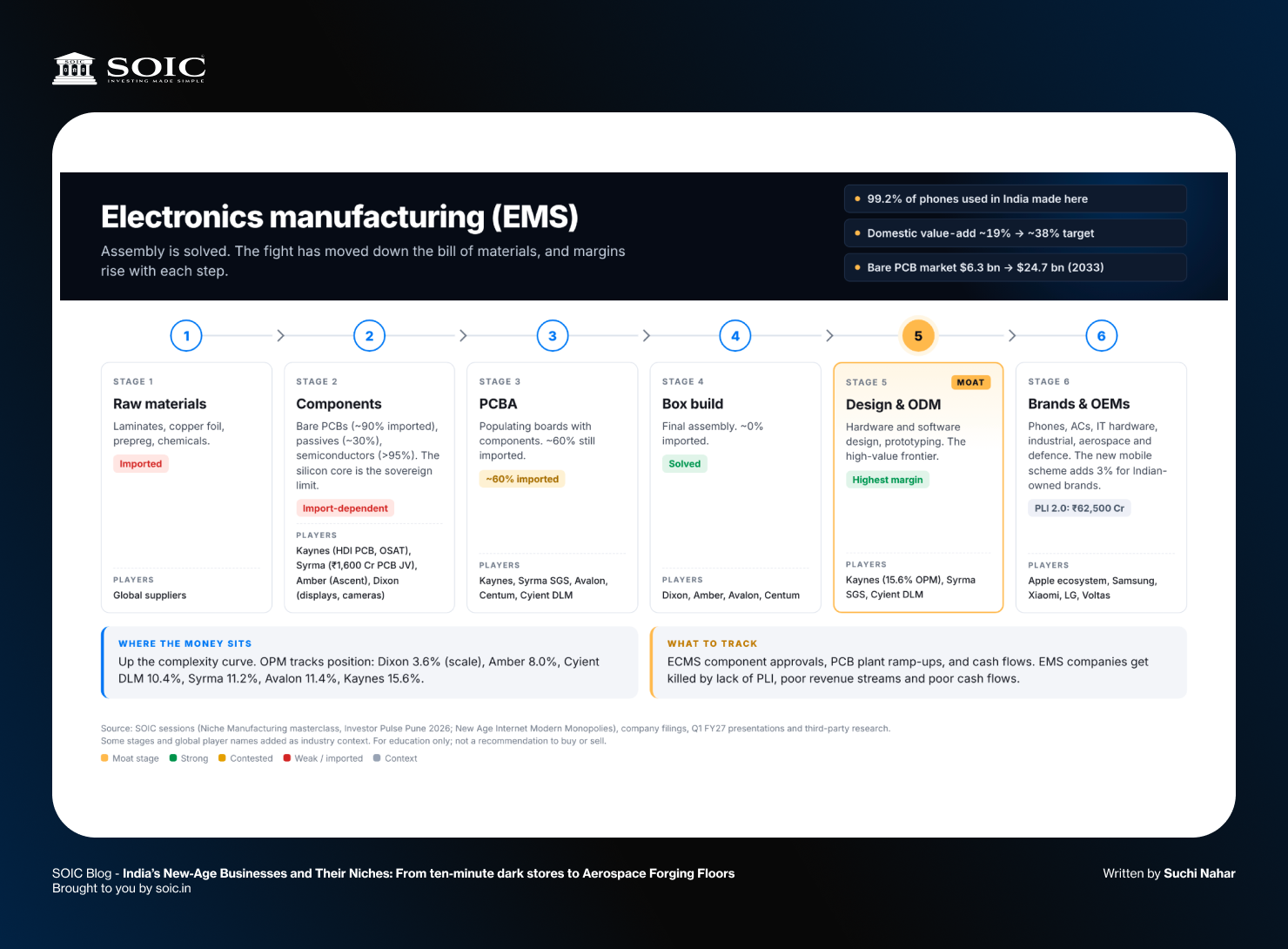
EMS: from assembly to the bill of materials. India makes 99.2% of the phones it uses. Assembly is solved, but ~90% of bare PCBs and >95% of chips are still imported. The new ₹62,500 Cr mobile scheme pays extra for local components and Indian brands. Margins follow position on the value chain: Kaynes (complexity, PCB, OSAT) runs 15.6% OPM; Dixon (scale first) runs 3.6%.
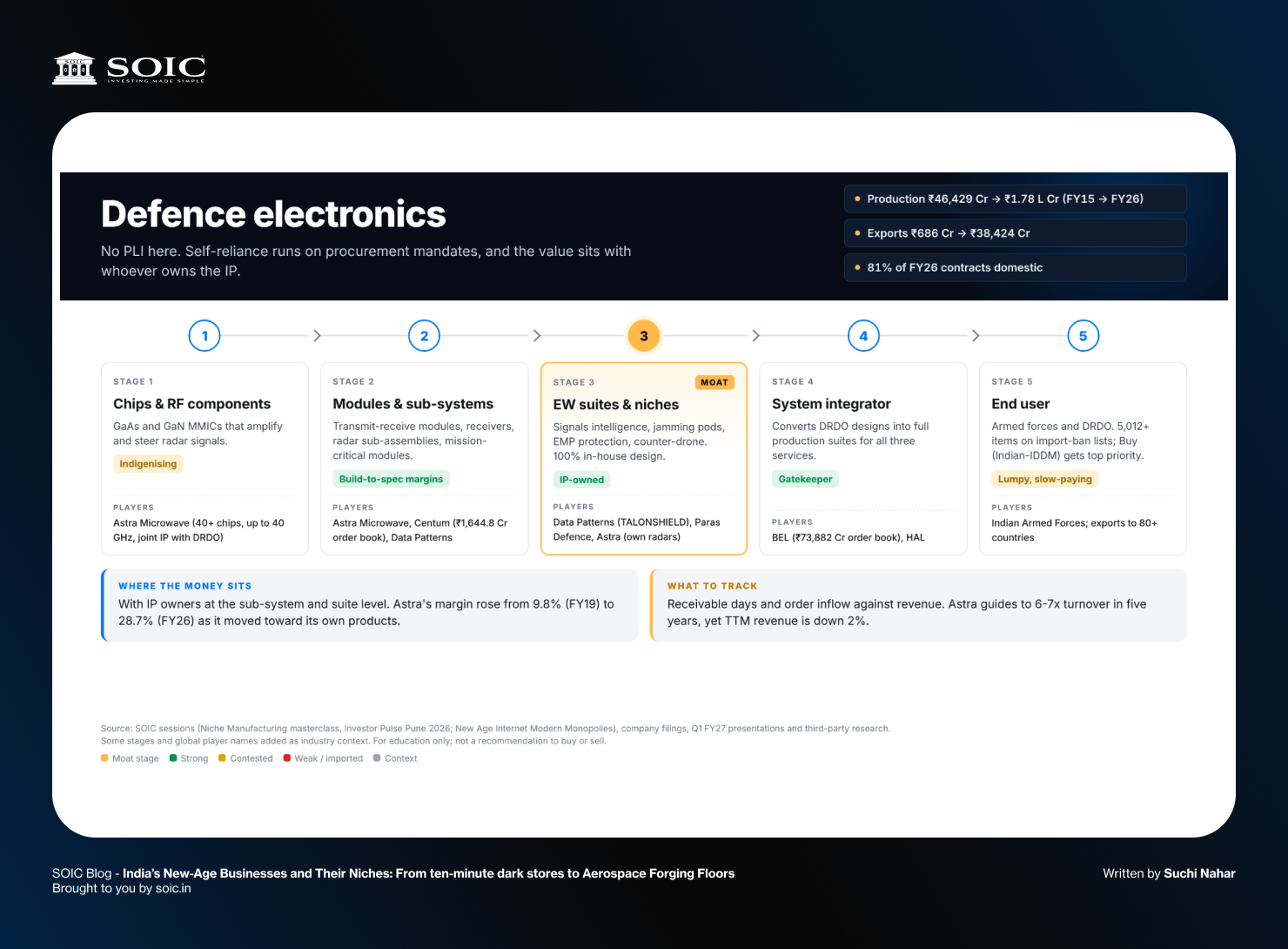
Defence Electronics: mandates, not subsidies. There is no PLI, just import bans on 5,012+ items. Domestic production went from ₹46,429 Cr (FY15) to ₹1.78 L Cr (FY26), and 81% of FY26 contracts went to Indian industry. Astra Microwave's management expects "at least six to seven times" last year's turnover in five years, and its margin rose from 9.8% (FY19) to 28.7% (FY26). But trailing revenue is down 2%, and the customer is the state. A promise is a hypothesis, not a cash flow.
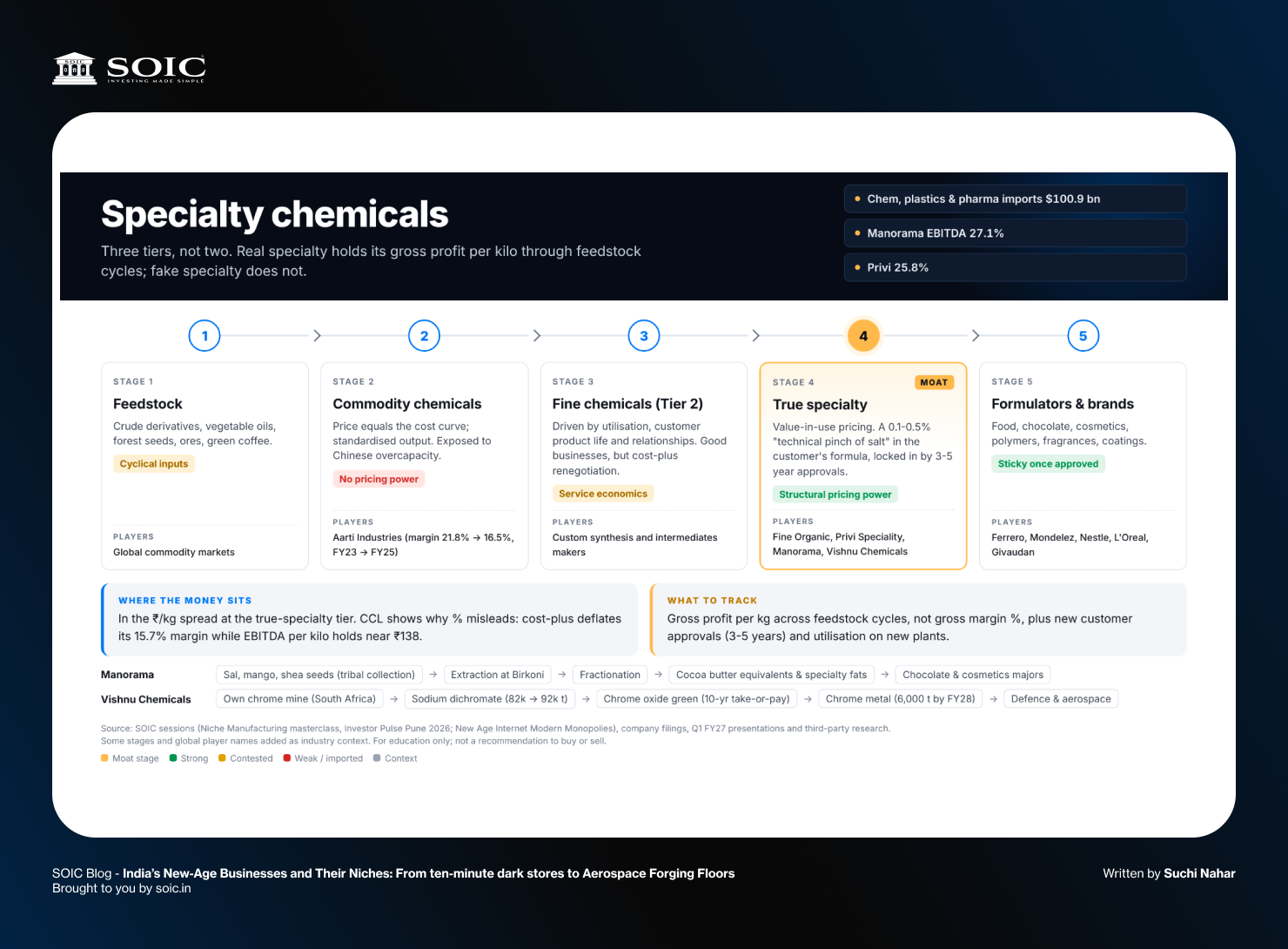
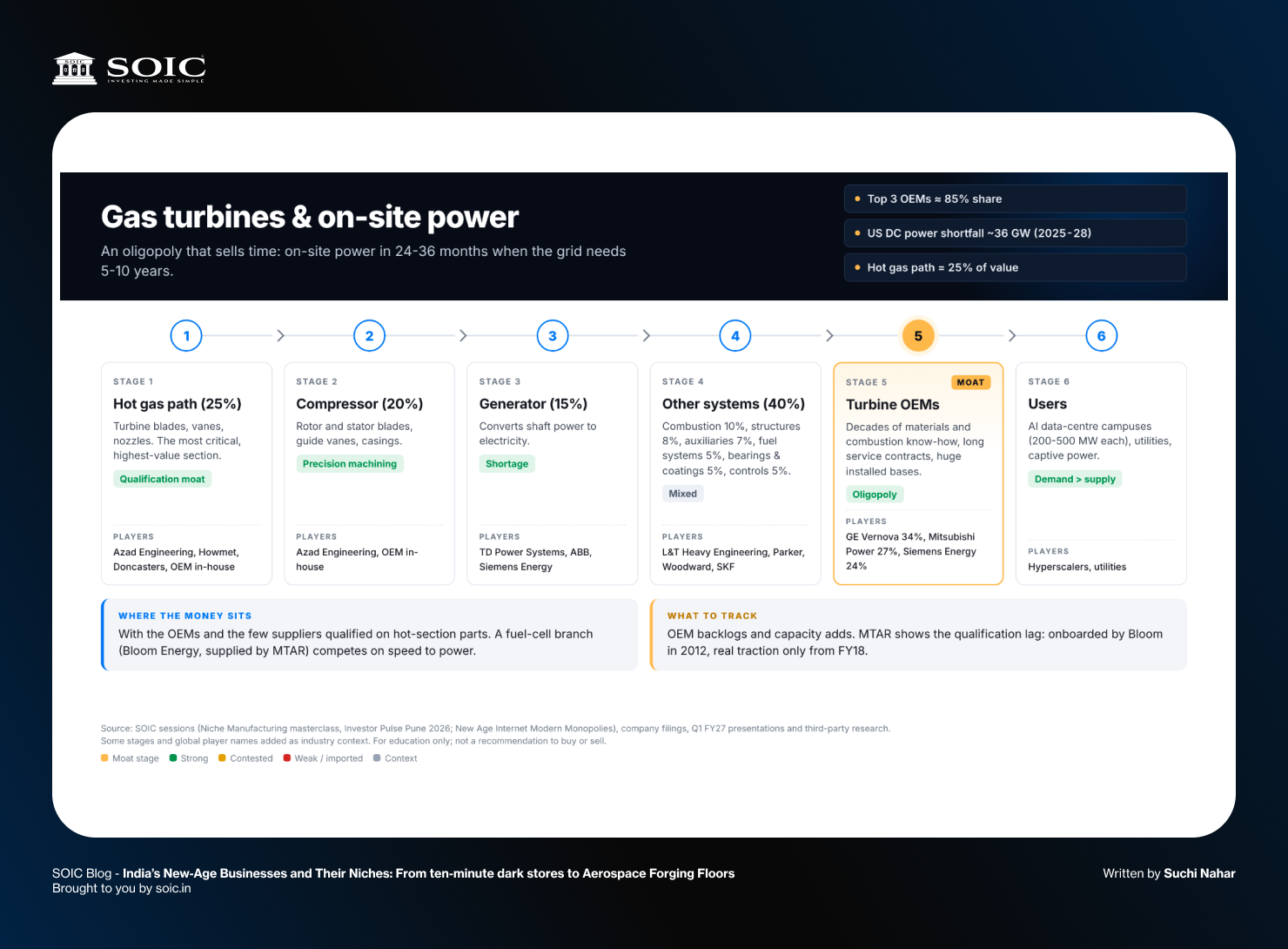
Grid and Gas Turbines: selling time. India's transformer manufacturing capacity is set to nearly double, from 375 to ~690 GVA by FY28E, which is both the bull and the bear case. Gas turbines power US AI data centers take 2436 months against 510 years for a grid upgrade, and three OEMs hold ~85% of the market. Azad Engineering and TD Power Supply are inside that chain. MTAR shows the real moat: Bloom onboarded it in 2012, and revenue only took off from FY18. Six years of qualification is a cost of replication no blank cheque can skip.
Capacity expansion progressing: The ~₹1,000 crore capacity expansion program is underway with ~20% incurred; more than 90% of the investment is in existing plants where land is already available, making the company's capex need lower than peers to produce similar or higher volume.
First, a warning on valuation. In lumpy or ramping businesses, P/E is highest at through earnings. Laurus traded at 243x in December 2024 because EPS had collapsed to ₹2.43. Value earning power (normalized margin, ₹/kg on the new order book, contribution per order at maturity), not trailing earnings. Then ask how much of the price pays for the earning plant and how much for the announced one.
The screen. The Monopoly Test and the manufacturing checklist are one instrument:
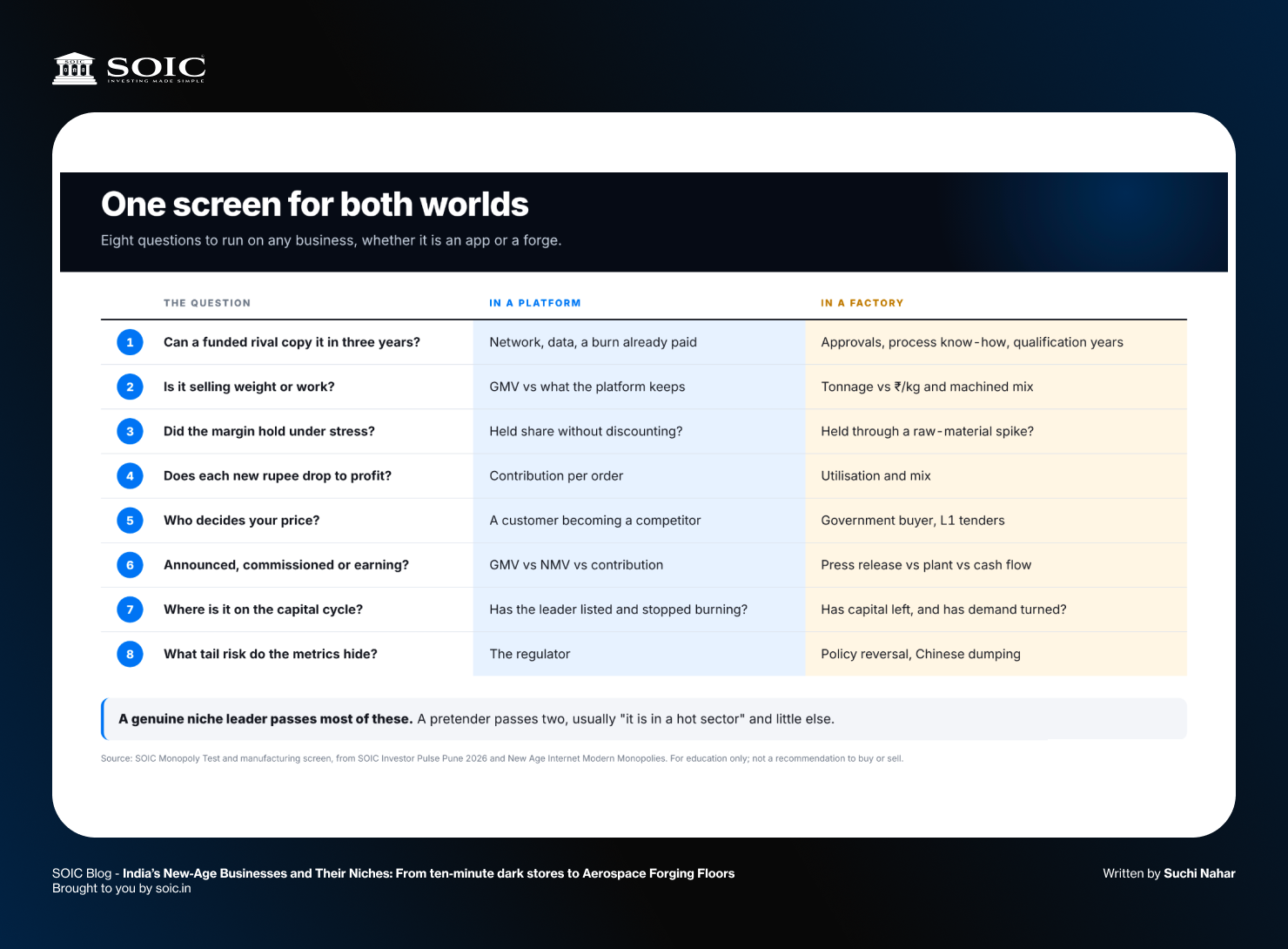
(1) Utilisation rolls over while capacity keeps rising;
(2) Order inflow grows slower than revenue for two quarters across the subsegment;
(3) US and EU OEMs defer capex;
(4) Tariffs fall, or trade normalises. For platforms, contribution per order falls while orders rise, one customer's share keeps climbing, or a deep-pocketed entrant starts funding losses from an annual budget.
The theme is real, but the winners are few. A handful of names in each niche will compound; the industries the government built will see capacity flood in and margins roundtrip. This is a hard sector with a good decade. Respect both halves of that sentence.
1. A good business is one that is hard to copy. Almost every company grows when times are good. The ones worth owning have something a rich rival cannot simply buy: a habit people won’t break, a teacher students trust, a cheaper way of delivering, or approvals that take years to earn.
2. A big market does not mean big profits. Ten-minute delivery and online coaching are huge markets. In both, one company made money while others burned thousands of crores. The winner was the one nobody could copy, not the one that grew fastest.
3. The world now wants factories closer to home. For thirty years everyone bought from wherever was cheapest, mostly China. Now countries want to make important things themselves, even if it costs more. That is a long opportunity for Indian manufacturers.
4. But making things is hard. Most factories earn thin profits. The winners stopped selling metal by the kilo and started selling finished, certified parts that customers trust. Same steel, nearly three times the price.
5. A press release is not a profit. A new plant announced is a promise; only a plant that is running and earning cash counts. Solar panels and batteries have far more announcements than earnings so far.
6. Know when to get out. Watch for factories running half-empty while more are being built, orders slowing down, foreign customers delaying plans, or government support being taken away.
The bottom line: India’s new-age businesses are a real opportunity, but only a few companies in each industry will win. Look for the one that is hard to copy, earns real cash today, and does not need a subsidy to survive. Steel is just the raw material; what the best companies really sell is trust.
Disclaimer: This blog is for educational purposes only and is not a recommendation to buy, sell or hold any security. Companies are mentioned to illustrate frameworks. Figures are drawn from company filings, presentations, earnings calls and third party research, and may have changed since. SOIC Intelligent Research LLP is a SEBI registered Research Analyst (INH000012582); the analyst and/or associates may hold positions in some companies discussed. Please do your own research.


0 Comments